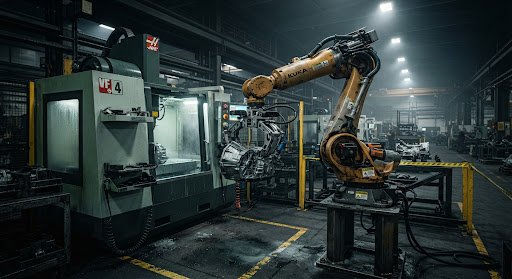
Scope of the cell’s work
A typical cycle may include:
- picking a part from a pallet, a feeder or another set place;
- recognising the position or orientation, if the feeding requires it;
- opening and handling access to the machine area;
- placing the part in the fixture and confirming correct clamping;
- taking the part out after the operation;
- passing it to the next stage, to inspection or to the place it is put down.
Not all operations have to be in one project. The scope is selected so as not to create unnecessary complexity.
Machine tending is not the robot arm alone. It is the cooperation of the robot, the gripper, the feeding, the machine, the safeguards and the error handling rules in one cycle.
When it is worth assessing a deployment
- loading and unloading operations are repeatable;
- the part has grip points that can be defined;
- the mass and dimensions fit within the possibilities of the configuration considered;
- the machine allows safe integration of access and signals;
- the way of feeding and collecting can be organised;
- the criteria of a correct cycle can be described and tested;
- automation matches the actual problem of work organisation.
When we do not recommend this direction
You should not start by buying a cell when the part cannot be gripped repeatably, the process changes in an uncontrolled way or the basic problem is unstable machining. A similarly cautious approach applies to heavily deformed, sticky, flexible or unpredictably arranged objects.
Automation may also not be the right first step when:
- there is no repeatable way of clamping the part;
- safe robot access to the machine cannot be ensured;
- the preparation time for further variants exceeds the benefit of automation;
- the required cycle leaves no time for picking, clamping and collecting;
- there are no set rules for reacting to a fault or an ambiguous case.
In such cases it is worth changing the organisation of feeding, the part or the process first.
What we assess before selecting equipment
| Area | Data needed for the assessment |
|---|---|
| Part | Mass, dimensions, material, surface, variants, grip points |
| Feeding | Position, orientation, containers, pallets, tolerated deviations |
| Machine | Model, fixture, doors, access, signals, integration limits |
| Cycle | Sequence of operations, cycle time, auxiliary times, exceptional situations |
| Environment | Space, contamination, temperature, movement of people and other equipment |
| Safety | Hazards, access, stops, rules of work and maintenance |
| Acceptance | Samples, test conditions, accepted results, way of documenting |
The assessment of photos and parameters allows the work to start. With incomplete data the engineer will indicate what must be measured, recorded or checked at the cell.
Stages of the project
1. Description of the cycle and criteria
We set out the work of the person and the machine and define what a correctly performed cycle means. We also take account of faults and borderline cases.
2. Concept of the mechanics and feeding
We assess the way of gripping, the orientation of the part, access to the fixture and the place it is put down. At this stage it may turn out that a change of tooling or of the organisation of parts is needed.
3. Selection of the robot and integration
The selection covers the requirements resulting from the mass, geometry and motion, not only the nominal catalogue parameter. We define communication with the machine and the environment separately.
4. Tests and exception handling
We check the cycle for the agreed parts and variants. The tests should also cover situations where the part is positioned badly, is missing, or the machine does not finish the operation.
5. Commissioning in line with the arrangements
The schedule and scope of work at the cell depend on the result of the assessment and the availability of the process. The acceptance and further cooperation terms are agreed individually before delivery.
AI only where it is needed
AI elements can support object recognition or adaptation to variation, but they do not replace the mechanics, the test data or the safety assessment. If the task can be performed stably with simple rules, such a variant should be considered in the assessment.